Sunday, October 30, 2011

Paul Tyler and 38 Degrees - pressure groups should be subject to scrutiny too!

Writing on the Guardian website last week, Lib Dem peer Paul Tyler took issue with the lobbying methods on the NHS bill of campaigning organisation 38 Degrees. He commented:

The kind of exaggeration 38 Degrees used made people ask whether simply filling up someone's inbox with a lot of half-constructed half-truths was a respectable way to campaign. The organisation had not asked people to engage with any of the detail of this issue, and had given a false impression about the headlines. Some would say this route leads us into a form of one-click rent-a-mob – what is now termed "slacktivism" – enabling ill-informed and disconnected instant electronic communication to take the place of genuine political discussion and interaction.
Regardless of the precise rights and wrongs on this specific issue, I think Paul Tyler highlights a wider point about the credibility and ethics of 'third sector' organisations and the campaigns they run and the free pass they are often given by the media.

So we see the NSPCC, which provides very little direct care for children, running ever more emotive advertising campaigns, which no doubt provide them with funds for another round of horror-movie-style ads.

Similarly, visiting a National Trust property earlier this year, I was shocked to see them running a disingenous campaign against the government's National Planning Policy Framework (NPPF), as if there every National Trust property was about to be surrounded by new housing estates. (The NPPF is far from perfect and many legitimate criticisms can be made of it, but this should not descend into caricature). Likewise, last year we had homelessness charity Shelter engaging in questionable use of statistics to generate publicity for themselves by attacking local authorities.

Third sector organisations are by no means necessarily noble and disinterested parties. They too have their vested interests - publicity helps them raise funds and gain competitive edge over their rivals. So they have every reason to make their claims sensational and their tactics noisy. Equally, they are likely to be represented by those well-versed in the political game. Campbell-Robb, the director of Shelter worked in the cabinet office under Labour; when MacMillan Nurses denounced the government over benefits earlier this year, their media spokesperson was former Labour parliamentary candidate Mike Hobday.

Of course, charities, NGOs, pressure groups and the like have a vital role to play in any democracy, but their arguments and campaigning tactics should be scrutinised as closely by the media and treated with a degree of scepticism. For that reason Paul Tyler's article is timely and welcome.

PS: I suppose for the sake of full disclosure I should mention that I had my own little local run-in last year with a well-known third sector organisation.

Friday, October 28, 2011

The Lib Dems have a duty to contest police commissioner elections

The decision of the Federal Executive that the party should not contest next year’s police commissioner elections is misguided and wrong. To be clear, FE hasn’t actually said that Lib Dem candidates must not stand, but there will be no federal funding for these elections and its suggestion that ‘Individual Liberal Democrats may support non party candidates’ is hardly a rallying cry for local parties to fight energetic campaigns.


Perhaps I will be in a tiny minority in feeling so strongly about this, but it seems to me that the whole issue has been bungled by the party from start to finish. As a result, we have a mess from which we don’t even emerge with honour intact.

The election of police commissioners was always going to be a problem for the party, as it was one of the few elements of the coalition agreement that provoked strongly-held and near-unanimous opposition among Liberal Democrat activists. Although it was clear that the coalition would have a change of heart on creating police commissioners, in practice it wasn’t a problem as the elections were to take place on the same day as next year’s local elections. So we could fight two elections for the price of one, just as we do when European and council elections are fought on the same day.

Then came this year’s disappointing local election results, in which a difficult situation was made worse by many non Lib Dem voters turning out to vote No in the referendum and Tory or Labour in the council elections. At the Lib Dem local government conference in the summer, there seemed to be a strong view from councillors, campaigners and defeated candidates that having police commissioner elections on the same day as the local elections would be disastrous for our chances of holding council seats, and this opinion was expressed very strongly to ministers etc.

I found myself a lone voice in arguing the opposite case. The referendum did harmed in the council elections because the Conservative party threw all its weight behind getting its supporters out to vote, as the referendum became a must-win for Cameron. By contrast, police commissioner elections would largely be a local matter, influenced more by the ground war than the air war and in my view there was little cause for alarm. In the past we have not been harmed in the past by having European and council elections on the same day – arguably the need to knock up our local vote has helped us to get more MEPs elected. Perhaps the most obvious comparison is with mayoral elections, and there too people largely treat them as local elections. In my view local government colleagues were drawing the wrong conclusion from this May’s double header.

This was not a popular view, however and there was near unanimity that the date of the police commissioner elections just had to be moved. But the consequences of the change of date needed to be considered also. If the police commissioner elections did not take place on the first Thursday in May, we would end up having to spend a lot of money and motivate activists to fight a set of elections that in most places we would have little chance of winning because of the size of the constituencies.

Regardless of whether it would help our prospects in council elections, the announcement in September that the police commissioner elections were being moved to November 2012 meant that it was highly unlikely that the Lib Dems would contest them seriously, or indeed at all.  Even before the date changed, the lack of urgency shown by the English party in developing approval and selection procedures for police commissioner candidates was a worrying sign that we were preparing to surrender without a fight any chance of influencing local policing. Likewise, at the recent federal conference in Birmingham there was a noticeable lack of training sessions, fringe meetings and the like on fighting police commissioner elections.

Federal Executive’s decision merely confirms what I feared. But while it may save the party money and spare campaigners the need to tramp the streets on cold, dark November evenings, it remains a bad decision. Effectively the national party is saying that having helped to create these posts it has no interest in ensuring that policing in our communities is carried out in line with Liberal principles. It is leaving it to the sheer chance of whether an independent, liberal-minded figure comes forward. Even then we are faced with the dilemma of whether to divert resources to campaigning for a non Lib Dem candidate or ignoring the election at the price of allowing authoritarian opponents a free run.

In my view, as a minimum, the central party should be look to use these elections as a campaigning opportunity. This would mean picking the best prospect of victory and treating it like a parliamentary by-election with the hope that at least one of the new police commissioners would be a Lib Dem. Elsewhere it should encourage the selection of candidates and a national campaign of talking to our supporters, to reaffirm their support, encourage them to vote in the police commissioner election and to recruit new members, helpers and so forth. In places with elections in 2013 this would help kickstart their campaign.

It occurs to me that there may be a Machiavellian hope lurking in some minds that by not contesting the elections, we are undermining their credibility and that if a series of local mavericks are elected the Conservatives will see the error of their ways and police commissioners will prove a short-lived experiment. I doubt whether this will be the case. Taking away people’s right to vote is unlikely to be popular.

Whichever way, the party nationally cannot expect to be taken seriously on crime policy if it effectively declares that it has no interest in taking responsibility for policing at local level. In my view it has a moral duty to contest these elections and the central party has a moral duty to give active support and encouragement to local campaigners to do so. Is it too much to hope that the party’s great and good will think again?

PS: Both Jonathan Calder and Anders Hanson have put forward strong arguments in favour of the Lib Dems contesting these elections.

Wednesday, October 26, 2011

One's a master spy, the other an Oxford scholar, yet neither can use a standard reference book

The recent conclusion of my time as a perpetual student means that I can now occasionally read books purely for pleasure, not as part of my studies. In particular, I can read the occasional novel, an indulgence largely foregone these last few years.


But perhaps because of years of studying obscure monographs and critiquing their arguments, I find myself doing the same with novels – reading them against the grain and searching for the weak link in the plot that undermines the rest of the story.

A case in point is the spy thriller Restless by William Boyd. The plot concerns the exploits of a woman working for British intelligence during the second world war and her revelation of this secret past to her daughter thirty years later as she seeks to resolve unfinished business.

To link the two time periods, Boyd has the mother (and spy) enlist the help of her daughter (an Oxford Phd student) to find the whereabouts of her wartime spymaster and lover who betrayed both her and his country. The only information they have to go on is a memory that at some point he received an honour, either a peerage or a knighthood. To track him down, the daughter has to consult her well-connected thesis supervisor, who seems to know everything there is to know about the great and good (or rich and bad).

At this point I groan and sigh. Our protagonist has been trained in the arts of espionage and can remember the most obscure details of what she has done and seen. Is it likely that she would be quite so vague about what honours have been conferred on someone she had once been in love with and who had tried to have her killed? Is it possible that neither our spy nor her Oxford scholar daughter would be aware that everyone who receives a peerage or knighthood is listed in Who’s Who? And just in case the villain tries to wrong-foot everyone by changing his name on being enobled, Who’s Who cross-references noble titles and family name. Each entry also gives an address for each subject, which would have relieved our heroines of the need for the elaborate piece of deception they engage in to be able to follow their quarry home and find out where he lives. It would have been so much easier to visit their local public library.

Marvellous things reference books! Yet I suppose if Boyd had allowed his characters use of them, the plot wouldn’t have been quite as exciting and I wouldn’t have had the pleasure of reading a whole book in a single sitting, something I haven’t done for many years!

Friday, October 21, 2011

Don't mention the civil war!

Just about caught up after a fortnight in Andalucia and ready to start blogging again. Andalucia is everything on expects from the guide book: wonderful scenery, centuries of architectural history reflecting that southern Spain was territory contested between Christian and Muslim worlds.

With my interest in more recent territory, I looked out for signs of commemmoration of the Spanish civil war. I realised, however, that since the return of democracy the so-called 'pact of silence' has meant there is little recognition by public bodies of the legacy of the war. Avoiding raking up its poisonous legacy was no doubt intended to help embed a new democratic system.

So I was surprised to see engraved on the facade of the Sagradio church in Granada the name Jose Antonio Primo de Rivera, a Falangist leader, who might have become a rival to Franco for the leadership of the nationalist causes, but who was executed by the Republican government in 1936. Around the inscription red paint has been splattered on the wall to symbolise blood.

I ask the guide of our walking tour about this. She tells me that recent legislation (presumably passed by the current socialist government) requires the removal of Francoist memorials from public buildings. But the church is exempt from this. It has clearly been unwilling to remove the de Rivera inscription and this has, quite rightly, led to protests.

While I knew perfectly well that the Roman Catholic Church aggressively supported the nationalist side in the civil war, one might have hoped that today it could be a focus for reconciliation, but evidently not. I ask the guide to what extent the church remains a right-of-centre political force in Spain, in a way that is not really the case in Britain. Diplomatically, she says: 'The church is still very powerful in Spain, and has plenty to say about Spanish society.'

Friday, September 30, 2011

Eric Pickles - a man who never puts the bins out

Others have written (here and here) about the Eric Pickles' latest daft idea of a £250 bribe for councils to revert to weekly collections of residual waste.

What strikes me is that Pickles doesn't understand the basics of refuse and recycling collections. While he cultivates the image of blunt, plain-speaking man, he is clearly so remote from everyday life that he never actually puts the bins out. Or else he would know that his proposals do nothing to achieve his stated goal.

According to the Daily Mail, Pickles says that:

My aim has always been to pass the chicken tikka masala test, so the nation’s favourite meal can be consumed on Friday night safe from the worry that two weeks later its remains will still be rotting in the bottom of the bin

But weekly residual waste collections don't achieve this. Leftover tikka masala goes into the food/garden waste bin, not general waste. Packaging goes into recycling bins or boxes. In other words, none of the chicken tikka masala or its packaging should end up in the general waste and none of it will be collected any earlier if councils moved from fortnightly to weekly collections.

The only way to end the rotting tikka masala nightmare would be to introduce weekly collections of food and garden waste. To their immense credit, Lib Dem colleagues in neighbouring Three Rivers have pioneered this, although they have met with little but begrudgery from the Conservatives. But Pickles is not proposing weekly food waste collections.

Wednesday, September 28, 2011

CD Review: The Jayhawks - Mockingbird Time

The Jayhawks' trademark sound was based on the harmonies of joint songwriters and frontmen Mark Olson and Gary Louris. It's sixteen years since they recorded together under the Jayhawks moniker, eight since the band sans Olson released a studio album and three since the two of them recorded the (under appreciated) Ready for the Flood album as a duo. So the reunion album Mockingbird Time  has been much anticipated by the band's long-standing followers.

Before the release of the new album they professed the ambition to be the band who produced their best album work later in their career and that Mockingbird Time would be it. This was always going to be a tall order, the more so as their 1992 release Hollywood Town Hall was not only a masterpiece in its own right, but also highly influential, indeed genre-defining.

And so it proves. While Mockingbird Time recaptures the band's classic sound as if a natural successor to Tomorrow the Green Grass, the last Jayhawks album to feature Louris and Olson, this time the songs are not quite there. In particular, the limitations present in Olson's solo work are in evidence here - I liken him to Stephen Stills, writing songs that are worthy and workmanlike but rarely memorable.

One of the things that made the Jayhawks interesting to listen to was the way their songs never went for the obvious hooks (perhaps this is why they never had a hit), but spun off in unexpected directions. That is still the case here, but there is a shortage of good tunes.

This is not to say this is a bad album - the band are too professional in their songwriting and musicianship for that to be the case. The Byrds-influenced 'She walks in so many ways' will be an automatic choice for any future 'Best of' compilations, while Louris's 'Pouring rain at dawn' captures the spirit of wistfulness that is present in all the Jayhawks' best work.

And none of the songs here are weak or embarrassing, it's just that for the most part they are a bit off the pace. One or two reviews I have read suggest that this is an album that grows on you, and perhaps that will be the case. But anyone looking for an introduction to the Jayhawks should still start with Hollywood Town Hall. And for contemporary work in the same vein, try the outstanding Nothing is Wrong by the California band Dawes, who sound like they have listened to a Jayhawks album or two in their time.

Friday, September 23, 2011

So farewell then, REM

Perhaps more surprising than REM splitting up is that they were still together after so many years of releasing indifferent material, with each new album being hailed as a return to form but flattering to deceive.

It also provokes me to reflect on a quirk in my own musical taste, namely a tendency to lose interest in artists I like as soon as they become successful. I was a relatively early follower of REM, first hearing them in 1984 at the time of their second album, Reckoning, and playing 'Don't go back to Rockville' endlessly. Their wistful, melancholic sound was unmistakeable, as were Michael Stipe's mumbled vocals that left you with the impression of profound lyrics that you somehow couldn't quite hear. For a while I would buy everything they recorded as soon as it was released. I even rather liked their much-derided third album, Fables of the Reconstuction (hence the youtube clip).

They seemed to be a band that would remain a reasonably well-kept secret, admired by those of use who enjoyed now following the mainstream. And then of course the sound got louder, Stipe stopped mumbling, 'Everybody hurts' followed 'Shiny happy people' and the secret was out. While Out of time and Automatic for the people were in their own way fine albums, to me they lacked quintessential REM-ness. One started hearing people describe themselves as REM fans, who hadn't heard anything they had recorded before 1992.

So, listening to REM was no fun anymore and I mostly stopped buying the albums. But once upon a time they were indeed special.

Why I have little sympathy for the 'Philharmonic Four'

As an avid reader of newspaper and magazine letters pages, I have often found myself annoyed by people expressing what is clearly a personal opinion, but sending it from their employers' rather than their home address. Academics are particularly guilty of this, and unless they are writing specifically on an issue of professional expertise, there can be no justification for it. Often one suspects they are using their university address to give added gravitas to their opinion on a subject where their opinion is no more expert than anyone else's. At worst author's can give the impression that their view represents that of the institution from which they are writing.

It is in this light that I view the suspension of the so-called 'Philharmonic Four' for signing a letter to the Independent objecting to the participation of the Israel Philharmonic Orchestra in the Proms. The signatories of the letter in the Daily Telegraph defending their right to express an opinion are (deliberately or otherwise) missing the point. The problem is not that the four musicians expressed a view publicly, but that they signed the letter as members of their orchestra.

When expressing an opinion publicly, in whatever forum, it's always worth being clear about on whose behalf one is speaking or writing. I post on this blog, and occasionally write elsewhere, in a purely personal capacity. Sometimes I have to speak or write officially as a Lib Dem councillor or group leader, occasionally as an executive member of Watford Borough Council. On the other hand I don't have a public-facing role in my permanent job and would avoid even the appearance of speaking on their behalf - for example by signing letters to the press from work rather than home.

And that's where the Philharmonic Four have come a-cropper. Had they each signed as 'musician', it's hard to see how their bosses at the London Philharmonic could have objected. But unwisely, they chose to mention their employers. Of course, one could argue that it's wrong to punish musicians for a practice that academics get away with all the time. Which would be a fair point. But it would be better all round if people avoided using their employer's name to add gravitas to the public voicing of their personal views.

Friday, September 09, 2011

The problem with the Rugby World Cup

As a fan of the game with the oval shaped ball, I should be rather more excited about the Rugby World Cup than I am. This is because it is a rather unsatisfactory tournament for one simple reason - there are too few games where the result is in doubt and likely to make a difference to who qualifies for the next round.

In soccer there is a sense that in any given match anything can happen. Algeria can hold England to a draw; the cup-holders can be eliminated without winning a game. Even the weaker teams who are unlikely to progress to the next round might have a say in who does qualify.

In rugby this doesn't happen - nearly every time the stronger team will win out, overpowering their opponents, and as teams are allowed to substitute nearly half their players during the course of a match, rugby's powers have ensured an even stronger bias in favour of the bigger rugby playing nations.

By my reckoning , of the 40 pool games only about six that could both be won by either team  and make a difference as to who qualifies. (Those involving Wales, Fiji and Samoa in Pool D and Scotland, England and Argentina in Pool B.)

Admittedly, the last Rugby World Cup did offer some surprises - Argentina's victory over France in the opening game, and their becoming the first country outside the traditional eight to reach the semi-finals and Wales's defeat at the hands of Fiji. Yet still the majority of games at the pool stage started as a foregone conclusion.

Rugby also has been poor at broadening its competitive base - Argentina still don't take part in a major international competition, as a result have not built on their success of four years ago and last month were reduced to playing one of their warm-up games against an English club side.

The tournament will open in a few hours with a game in which the only matter in doubt is whether Tonga will be able to restrict New Zealand to a margin of victory lower than 50 points (unlikely). So I shall wish the underdogs well (other than those playing Scotland or, in deference to my dear wife, Wales) but suspect I won't be watching all that many games.

Monday, August 22, 2011

On prejudice against country music


The Independent's pop music critic Simon Price excuses his surprise at learning that the country and western artist Brad Paisley sold out the O2 arena by saying 'he operates in a genre which still dare not speak its name in sophisticated company.' He adds:

The one thing, in the great tribal Taste Wars of the Eighties, that everyone could agree on was that country-and-western was rubbish. Even its main British proponent had to sneak past the defences by giving himself the self-consciously wacky name Hank Wangford.


While it's certainly the case that people who should know better unthinkingly mock country music, the above comment is testament more to the author's ignorance than anything else. While there was plenty of cheesy and naff country music around in the 1980s that was only part of the story. Elvis Costello recorded an album of country and western standards that spawned hit singles. Bands like Jason and the Scorchers and the Long Ryders fused country and punk influences in a way that was just as reverential to the former as the latter. And Paisley Underground bands such as REM, while hardly belonging in the country section of record shops, were clearly influenced by country music traditions.
If all of the above don't qualify as country, there were plenty of respected artists around who did. Steve Earle (see youtube link) was a kind of country-and-western Bruce Springsteen. Dwight Yoakam revived and reinvented traditional, hard-core country, while Rosanne Cash, kd lang and Nanci Griffith each emerged as serious songwriters working within a country-and-western tradition.
 
Simon Price's comment is a bit like saying all rock music is naff and citing the oeuvre of Cliff Richard as proof.

Thursday, August 18, 2011

Total Politics blogger awards voting thingummy

I don't really approve of such beauty contests, but in response to the various pleas (now I know how voters feel when they are knocked up) have given in, logged on and voted.

But those folk at Total Politics don't make it easy. For your vote to count you have to name five blogs, then separately name five bloggers, write 'Blank' down the rest of the list, designate the Blank by category (I thought 'Non-Aligned' was best) then name your favourite twitterer or whatever.

It took me three goes to cast my vote successfully. If I didn't have better things to do I wouldn't have bothered.

More on Richard Webster

There is an obituary at the Good Enough Caring blog by Mark Smith of the writer Richard Webster, about whom I wrote recently. It might seem a little eccentric of me to post twice about a relatively obscure writer whose work is a little removed from the normal subject matter of this blog.

But one of Webster's preoccupations was the concept of 'noble cause corruption' - how people can be less than scrupulous methods in promoting a cause that they believe to have an overriding good. It is regular, if intermittent interest of mine, and part of the reason for the name of this blog.

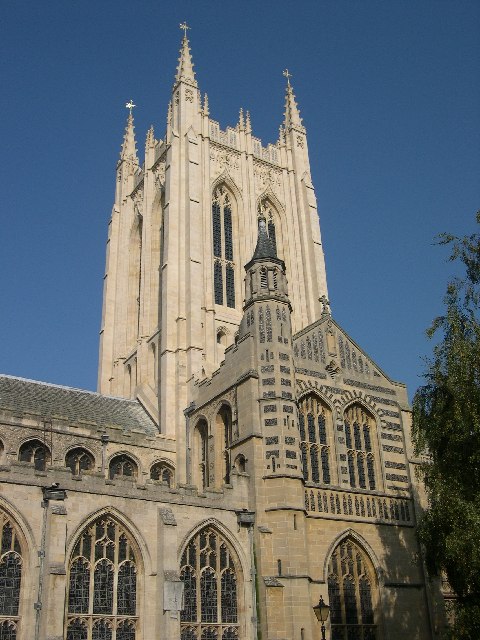
At St Edmundsbury Cathedral

The weekend took me to Bury St Edmunds where I was surprised and delighted to realise that the Perpendicular Gothic tower of St Edmundsbury Cathedral was completed as recently as 2005. I didn't think they still did that sort of thing, and can imagine voices saying that there were better causes to spend the money on, or that additions and alterations to the cathedral should be in a contemporary rather than traditional style. The architect Stephen Dykes Bower, was a Gothic revivalist and official 'Surveyor of the Fabric' for Westminster Abbey. When he died in 1994 he left a legacy to St Edmundsbury so that the tower could be completed.

We were told by a guide that before the tower was completed there had indeed been many local people who were sceptical of the tower project, but now it was finished there was almost universal agreement that it was worthwhile. Which I suppose goes to show that sometimes it is worth being bold and courageous even where a project is not universally supported.

Friday, August 12, 2011

The riots: are Labour no longer quite so tough on crime?

It was predictable that figures on the left of Labour such as Ken Livingstone and Diane Abbott  should be quick to link the riots to the coalition government’s spending cuts. Less so perhaps that the party’s deputy leader and New Labour establishment figure Harriet Harman should do the same. It raises the question of whether Labour’s curious journey on crime has come full circle.


Back in the 1980s one could be forgiven for thinking that much of the Labour party, while by no means condoning crime, believed that much of it was an understandable if regrettable response to Thatcher’s cuts. Labour viewed the police with suspicion, particularly after the miners’ strike. At local level they could be reluctant to support initiatives like Neighbourhood Watch, or to tackle low-level criminal and nuisance activities that later became known as anti-social behaviour.

Such attitudes were doubtless sincere enough, but they didn’t play well with the sort of voters Labour needed to win a general election. As Labour’s shadow home secretary, Tony Blair set about mending fences with the police and changing Labour’s rhetorical tone to the ‘tough on crime, tough on the causes of crime’ formula. In doing so he managed to neutralise a perceived weakness of the party. But this wasn’t enough.

When Blair took over the leadership, one of New Labour’s trademarks was establishing that they were the party that was toughest on crime. To this end, the Blair government introduced endless new pieces of legislation and hundreds of new criminal offences introduced in a bid to outflank all comers (including the Tories, the traditional law and order party) on the right on crime policy. Labour were the party that was against crime, so by definition their opponents, especially the Lib Dems, weren’t. (See Nick Cohen’s book Pretty Straight Guys for more on this.)

Any attempt by opponents to suggest that things were more complex than government propaganda implied was derided as a sign that they were ‘on the side of the criminals’. I never ceased to be surprised at how easily Labour activists (even those who were active in the 1980s) adopted this rhetoric, using their ‘tough on crime’ versus ‘soft on crime’ mantra in leaflets, attacking opponents for not issuing enough ASBOs etc.

Now, and perhaps because they can’t resist attacking the cuts, Labour’s tone has come over all atavistic. It is true that in his House of Commons speech Ed Miliband did not blame the cuts for the riots. But one could well imagine that if the riots had happened two years ago, and Nick Clegg had made a similar to speech to the nuanced one Miliband made yesterday, Labour would have been very quick to spin the final section of it as condoning the rioters .

If this event marks a rowing back from Labour’s ‘tougher than the rest’ approach to criminal justice then that is to be welcomed. Things are indeed more complex than being either against crime or in favour of it. A sensible debate free from emotive posturing would be a good thing. Yet in the cold light of day Labour will wish to avoid any hint of appearing as apologists for the rioters, thereby compromising position on law and order. But I can well imagine that Conservative, and perhaps even Lib Dem strategists will be itching to turn Labour’s past rhetoric back on them. Indeed this may well already have started.

Wednesday, August 10, 2011

The Liberal party and the Spanish civil war

Sticking to a historical theme, I notice we have just passed the 75th anniversary of the outbreak of the Spanish civil war. Following the nationalist rebellion in July 1936, the main European powers pursued a policy of non-intervention that was flagrantly flouted by fascist Italy and Nazi Germany.

One of the tragedies of this conflict was how lukewarm, the major democracies were about preserving democratic government in Spain (however flawed it was) and standing up to dictatorship. Most people who have any knowledge of this period will be aware of the International Brigade who fought to defend republican Spain. But what was the position of the British Liberal party? Well-meaning enough, it would seem, in calling for the spirit of non-intervention to be maintained, but hardly heroic. In his book Liberals International Relations and Appeasement, Richard Grayson writes

The Liberal Party never came to see events in Spain as an opportunity for making a stand against the dictators, as the party's main aim was to ensure that the war remained an internatl dispute. By the time it became apparent that this would never happen, it was too late. The work of Wilfrid Roberts, the Liberal MP for North Cumberland, as a political and humanitarian campaigner for the Republic was the only significant Liberal contribution to the struggle.

Journal of Liberal History Issue 71

I see that the summer edition of the Journal of Liberal History includes my review of Ross McKibbin's Parties and people: England 1914-51.

More than that it there are articles by Martin Horwood MP on Cheltenham's Liberal history, Ross Finnie on Russell Johnston and Kevin Theakston on the afterlives of former Liberal prime ministers. It's an impressive achievement of Duncan Brack (who must also be busy with other things) and his editorial team to keep producing this quarterly journal, which is not only highly-readable, but contains original, peer-reviewed research.

Subscriptions are a bargain at £20, giving also membership of the Liberal Democrat History Group. By subscribing you will not only have an enjoyable read four times a year, but also helping to promote interest in the rich and diverse history of the Liberal Democrats and their predecessor parties.

Saturday, August 06, 2011

Pickles on town centre parking: ignoring the evidence, playing to the gallery

Anyone who has been involved in local politics or community and residents' groups will recognise the following: the person who knows for certain the solution to all an area's parking, traffic and transport problems, who is completely confident that his solutions are the only possible way forward and that only idiot councillors and officials could fail to support everything he proposes. He dismisses all counter-arguments as 'rubbish' and is unable to conceive of alternative points of view, let alone how many of his neighbours see things differently.

For the most part, the job of elected representatives is to listen to all viewpoints, consider the nuances of any policy issue and try to find the best way forward. Sadly, today we have Mr 'I Know Best About Everything' as secretary of state for communities and local government, and his latest pronouncement is that 'fairer' (i.e. more) parking in urban development will help to boost high streets and town centres. Although couched partly in terms of giving councils more freedom, the logic of Mr Pickles' rhetoric is that councils ought to end 'anti-car restrictions' and encourage more parking. This is all part of 'ending Labour's war on the motorist'.

In fact, while Labour's policy was dirigiste in the extreme, they merely continued and strengthened the approach taken by John Gummer in the previous Conservative government. Whether because of genuine support for the sustainability agenda, or because Conservative voters were angry at increasing greenfield development, high streets being destroyed by out-of-town shopping centres etc., the Major government began to re-think planning policy. Whereas since the 1960s the planning system had encouraged low-density development, which militated in favour of building on greenfield, out- and edge-of-town sites, the government now tried to encourage urban renewal, particularly by ending restrictions that meant town centre development had to have suburban levels of parking, amenity space and the like, which had made regeneration more difficult.

So trying to limit parking in urban development was not simply a perverse attack on motorists, but a rational response to planning and transport issues that was broadly shared across the political spectrum (even if Labour were unnecessarily control freakish about it).

Living Streets has posted a brief but pointed critique of Pickles (hat-tip Jonathan Calder). But Pickles would probably regard Living Streets as exactly the sort of tree hugging organisation that wages war on the motorist. So let's look at the practical, straightforward problems with increasing town centre parking that someone only slightly more open-minded than Mr Pickles might sympathise with.

In the first place, many town and city centres suffer from traffic congestion, which can be very frustrating to motorists. Providing more and cheaper car parking to encourage people to drive into town, rather than use other transport methods, will only add to motorists' frustration without doing much to improve town centre economies. Unless of course the government funds a massive road-building programme to enable people to drive to the new car parks. But even those not worried about the unsustainability of such an approach might recognise that large-scale urban road building has hardly been a panacea for town and city centres.

Secondly, parking space provides less economic benefit than business floorspace or housing (it certainly attracts lower business rates) so more parking really doesn't offer good value for money or make urban development more viable. Given the space constraints that often affect urban sites, developers forced to reduce the number of homes, offices or shops in a scheme in order to provide more parking may well seek to develop out-of-town instead, where there is plenty of room for everything. Which will kind of undermine the notion of improving the economic health of the high street.

Lastly, on Pickles' criticism of 'parking fines, soaring parking charges and a lack of parking spaces'. These are things that can and do contribute towards making town centres work effectively. Without parking charges and regulation, spaces would be used by commuters that are needed by shoppers on whose custom town centres depend. Parking controls, pedestrianisation and the like can also help to create reasonably pleasant town centre environments that people want to visit: i.e. that are safe for children, aren't full of car fumes, and either traffic jams or fast-moving traffic. While Pickles claims to want to 'assist mums struggling with their family shop' his policies would make things worse for them: added congestion during their journey, supposedly free car parking spaces already taken up for the day by town centre workers and a feeling that this isn't a safe or environment to bring your children to.

I am not sure which is worse: the thought that Pickles can't and won't understand such arguments, or that he understands them perfectly well, knows his policies will make little practical difference, but is just playing to the gallery to give the impression that there are simple solutions to problems that are in fact rather complex.

(Later): I see my dear wife is advising me not to get wound up by Mr Pickles.

Jayhawks live at the HMV Forum, Kentish Town

To the HMV Forum last night to see The Jayhawks perform in their classic, mid-90s line up, for the first time in 16 years. They have a new album coming out in the autumn, and apparently the reunion is permanent rather than a one-off tour.

The last time I saw the Jayhawks in this incarnation they appeared set to make the commercial breakthrough with their single 'Blue'. They were supported by a little-known band called Wilco, who were less than memorable (in fairness their first album A.M. released that year gave little hint of the great things to come.) But it was Wilco who made it big, while the Jayhawks lost one of their two main songwriters and remained in obscurity.

This reunion would have once seemed very unlikely. But it is still very welcome. Last night they were in fine fettle, trademark sound intact and the harmony singing of their two leading lights Gary Louris and Mark Olson to the fore. The overwhelming majority of the set came from the two albums for which they are best known, Hollywood Town Hall and Tomorrow the Green Grass, released before Olson left the group in 1995.

Much to enjoy and praise therefore. The only disappointment is the virtual absence of material from the three albums released after Olson's departure. Nor was there anything from last year's Ready for the Flood album by Olson and Louris without the Jayhawks. Perhaps it's a tact and diplomacy thing within the band, so they are pretending the years between 1995 and 2010 never happened. But those of us who have followed the Jayhawks through their career might have wanted a more representative set (or at least I did).

But it's a minor quibble. It was an excellent evening, they played many of my favourite songs, the new material sounds promising. Who knows, maybe this time around they will win the wide audience that their previous work deserved but never got.
I couldn't find a decent clip of their 2011 tour, so the above from 1995 introduced by a very young-looking Jon Stewart will have to do.

Friday, August 05, 2011

Cultural historian Richard Webster dies

I was sorry to read of the recent death of the cultural historian Richard Webster, who was the subject of a belated Guardian obituary a few days ago.

Although he wrote on a range of subjects, from Freud to the Salman Rushdie affair, he was best known in recent years for his work exposing injustices suffered by residential care workers arising from the 'trawling' methods used by the police when investigating cases of historic child abuse.

While Webster was very clear that abuse can and did happen ('some of those who are now in prison are there for no other reason than that they are guilty of the crimes alleged against them'), he argued in his compelling and thoroughly-researched book The secret of Bryn Estyn that there many innocent people had ended up accused and convicted, as a result of (in the words of the Guardian obituary) 'public hysteria, fuelled by credulous journalists and ratified through inefficient police investigative techniques'.

This was a brave stance to take, and one that was predictably often misrepresented by those he criticised. He was clear that the basis for paedophile (and other) panics was not the anger of the mob. Instead he argued that:

'Witch hunts don’t happen without an educated elite behind them. In the past, bishops and priests let panics loose. Today it is the police, social workers and broadsheet journalists.'

He used the phrase 'witch hunts' not as lazy journalese but as one who had studied the read phenomenon of medieval witch hunts.

Although an atheist himself, he believed that a modern, secular, rationalist society, confident that it had left religious superstition behind, was actually more rather than less susceptible to such collective fantasies than were those of previous eras:

The widespread belief that, belonging as we do to a rational scientific age, we are no longer vulnerable to such fantasies, is itself one of the most dangerous of all our delusions.

In many ways this was the unifying theme in his diverse body of work. His website, which collects the eclectic range of essays he wrote, remains available for the time being.

See also this review of The secret of Bryn Estyn by Edinburgh University academic Mark Smith, which is published on my father's Good Enough Caring website.

Saturday, July 30, 2011

Glasman Staggers

The New Statesman has fallen over itself to come to the rescue of Maurice Glasman after his faux pas in calling for a total ban on immigration. There was a sympathetic editorial last week and an article by the great man this week.

All of which is fine - Glasman has interesting things to say and the Blue Labour concept is a sign of how all parties these days are to some extent embracing community politics.

Yet it is hard to imagine that if any Conservative or (God forbid) Lib Dem figure had made similar comments, the Staggers would have given them such an easy ride.

The message is clear: it's OK to make unacceptably right-wing comments, so long as you're Labour!

Obscure moments in Liberal history: How Lembit Opik deprived Dan Falchikov of a seat on the NUS national executive

I see that Dan Falchikov has a reservation or two about Lembit Opik's campaign to become Lib Dem candidate for Mayor of London.

What I suspect even Dan doesn't remember is that long ago Lembit effectively denied him a place on the prestigious and exalted National Executive of the National Union of Students.

As a student in the 1980s I developed the eccentric habit of standing for election for the Leicester University delegation to the NUS conference. A couple of times I even got elected, finding myself the lone Liberal among leftists of various stripes. This was also pretty much the balance of representation in the conference as a whole.

In 1987 the Liberals were hoping to retain their single seat on the national executive. Dan was our candidate. His best chance of election was for one of the 12 part-time posts, which were elected by STV in blocks of 3, 4 and 5. As STV afficionados will realise, our best hope was in the block of 5, which needed a lower quota to be elected. There should have been enough committed Liberal or SDP delegates, together with non-aligned non-socialists to scrape a seat.

Unfortunately, Lembit, standing as an independent, spoiled everything by contesting a seat in this block. He had enjoyed positive national coverage as president of Bristol University Students Union during the on-campus demonstrations over Professor John Vincent's Sun column. He then garnered an impressive number of votes in losing to Labour for NUS President. So he could have won a seat in the more difficult elections for the blocks of three or four. But by standing in the block of five he siphoned off the floating votes that we needed to get Dan elected and left the NUS national executive without Liberal representation for the first time in many years.

I am slightly ashamed of remembering all this - it marks me out as a true political anorak. But it was Lembit's first venture onto the national stage. Had things gone only slightly differently, it might have been Dan who ended up as an MP in rural Wales with semi-celebrity status, and Lembit as a "plain-speaking" blogger and party activist. But I suspect Dan wouldn't have blown a 7,000+ majority. And he's certainly right about the folly of Lembit's mayoral campaign.

Friday, July 29, 2011

Who's to blame for the lack of a core Lib Dem vote?

Via Iain Roberts on Lib Dem Voice, I spotted Simon Titley’s article in the latest issue of liberator about the failure of the Liberal Democrats to build a larger core vote. Unfortunately, Simon does his usual trick of spoiling some interesting arguments by descending into Pythonesque ranting:

If you have ever held back from proclaiming liberal values because you were afraid it might offend someone, it’s your fault. If your Focus leaflets are a politics-free zone, full of hackneyed slogans that haven’t changed for thirty years, it’s your fault. If you think “we can win everywhere” is a satisfactory strategy, it’s your fault. If you think the party can advance solely by a ‘ground war’, it’s your fault. If you think the party can advance solely by an ‘air war', it’s your fault. If you are an anti-intellectual who rejects political thought and debate because it gets in the way of leafleting, it’s your fault…[etc. etc., you get the picture.]
I don’t suppose anyone would answer to the full pantomime villain description conjured up – ‘Yes, I’m an anti-intellectual who rejects political thought’. But, as one who has spent much of the last quarter-of-a-century writing leaflets, helping to organise local and parliamentary election campaigns, while making the political and intellectual compromises that go with such territory, I can’t really avoid considering myself among the accused. The party’s present plight is in a sense all my fault!

But before I book myself into a political re-education camp to be reprogrammed in the ways of Liberalism, let me put in a plea of mitigation on behalf of myself and fellow defendants.

For most of the last century the main political discourse in Britain, the core choice for voters, has been between a small state/capitalist/middle class party and a social democratic/big state/working class party. Voters choose their government from these two options. The Liberal Democrats (and their predecessors) haven’t neatly fitted into this battle and emphasise values that are outside the main debate. We are asking people to opt out of the big decision about who governs and vote for us instead. Which isn't easy, because when it comes down to it most people are likely to have a preference for Labour or Conservative government and a temptation to vote for one to keep the other out of office.

This wouldn’t matter if we had proportional representation. Under a fairer electoral system we could market ourselves as a niche party, drawing support from voters who care about distinctively Liberal issues: civil liberties, workplace democracy, environmentalism, a humane criminal justice policy, constitutional reform and the like. By emphasising such matters in our campaigns, we could build up a small but loyal core support. Perhaps around 10% of the electorate would vote for such an agenda, much less than the Lib Dem vote share in recent elections. But it wouldn’t matter because we could be confident of regularly winning 50 or so parliamentary seats, with reasonable hope of regular participation in government as a junior coalition partner, and exercising a distinctively liberal influence when we do.

But we don’t have proportional representation. Even the largest imaginable core Liberal vote would win us few councillors or MPs. To be politically relevant we need to win council and parliamentary seats under first-past-the-post. Usually this means winning at least 40 per cent of the vote in any given electoral area, more than any core Liberal vote we could dream of. And that militates against taking very controversial positions on major issues, or going on about things that are distinctively Liberal, but which the average voter regards as cranky. To broaden our support, we have gained success through community politics, in particular as adapted by Chris Rennard for parliamentary elections, tactical voting and the idea of Lib Dem MP as local hero. This has meant talking about the issues that matter to voters in ways that make sense to them. As we now have 57 MPs, something that many of us could have barely imagined when we joined the party, our campaigning methods have had some success. They are also not so very different from what the other parties do. Thatcher, Blair and Cameron have in their own way taken their core vote for granted and aimed at winning the support of the uncommitted.

Yet there is a problem here. Perhaps because of the party’s reliance on the genius of Chris Rennard, we have ended up with an over-mighty campaigns department always focused on getting votes in the next election, not in campaigning for distinctively Liberal causes or values. It can be a cause for mockery if someone mentions constitutional reform Europe or civil liberties in a Focus leaflet. The lack of willingness to campaign in a distinctively Liberal manner does get noticed. The drug law reform charity Transform pointed out at the last election that:


Whilst the Lib Dems appear to have made the intellectual journey on drug policy reform… it remains an issue on which they have generally been defensive, (choosing to avoid - sometimes even deny) rather than one they actively campaign on.
Which is fair comment, except that Transform don’t have to fight elections while being vilified by opponents for being ‘soft on drugs’.

There is a difficult balance to be struck between winning enough votes and seats to keep us in the political game versus promoting a distinctive Liberal identity. Those of us charged with campaigning for the party, whether at local or national level have not always got the balance right. But, just perhaps, the problem is a little bit more complicated than Simon Titley suggests, and is deserving of reasoned discussion rather than abuse and blame.

Wednesday, June 08, 2011

Lib Dems should not be threatening constitutional trickery to stop Scottish independence

A very good post from Dan Falchikov on Lib Dem Scottish secretary Michael Moore's comments on Scottish independence. Dan writes:

By saying that a second referendum is needed (no doubt to be followed in quick succession by Labour and Tories) Michael Moore again allows the party to be seen to be on the wrong side of the debate and trying to illiberally block the expression of the will of the Scottish people.

There is a danger that the Lib Dems north of the border have become part of the establishment - a sort of rural and suburban version of the Labour party, and arch defenders of the union. It was certainly not always so. Liberal support for Scottish home rule has long historical roots, and before the SNP won seats in the Commons, the Liberals were the only party in parliament supporting devolution.

There is surely a great deal of political territory between supporting independence and using questionable constitutional procedures to prevent it happening. The result of the recent Scottish election shows that voters are at the very least willing to support a referendum, whatever they decide when it happens. Lib Dems ought to respect that wish, welcome the fact that voters can have their say, participate enthusiastically in the debate, make the case for maximum autonomy within the United Kingdom and be willing to accept the outcome whatever people decide.

In saying this I'm letting my head rule my heart. I don't want Scotland to become independent, because I value the union. Indeed I'm a product of it - having a Scottish father and an English mother, supporting Scotland in sports internationals, living in England, but having spent formative years residing north of the border. I would like Scotland to remain part of Britain. (I agree with David Mitchell's recent Observer article on this theme.)

It's not for me to decide, though, but rather for those who live and vote in Scotland. Wistful sentiments from Anglo-Scots will doubtless be counterproductive in protecting the union, but more so will British ministers trying to think of artificial obstacles to thwart Alex Salmond. A revival north of the border, and a successful defence of the union, will require Scottish Lib Dems to show that their hearts (and heads) are in the highlands (and lowlands) of Scotland not in Whitehall and Westminster.

Why are there no Lib Dem media pundits or public intellectuals?

In her excellent New Statesman blog, Olly Grender asked last week why there are no Lib Dem columnists in the mainstream media. She wrote

Right now, I can think of five journalists, all working in print media, all of whom at some point have been part of the Liberal Democrat party, but who would run a million miles before declaring themselves long-term supporters.


For me, the problem goes wider than this and applies equally to the lack of public intellectuals - academics who write for a general audience, serious journalists and commentators - who identify with the party. I suspect that this is partly because the academic world, just like the media, tends to operate on a left-right axis and it's hard for a distinctively Lib Dem worldview to fight its way into public discourse. It is also the case that the Lib Dems themselves have not always made the best fist of articulating our philosophy and how that guides our policies. (I think this is what people mean when they talk of our 'narrative').

So when Vince Cable was being lionised in the media as the person who foresaw the economic crisis, there was no real sense of this reflecting well on the party, that his insight reflected a distinctively Liberal economic approach. Although he was Lib Dem shadow chancellor, he was presented in the media more as a Frank Field-style maverick than a representative of the Lib Dems. Although it's not hard to find people with strong academic credentials within the party, we have no equivalent of Philip Blond or Anthony Giddens publishing work for a general readership from a Liberal Democrat viewpoint.

The other side of the coin is that even on an issue that we ought to own, such as localism, the two public intellectuals most commonly associated with this cause, writer and pundit Simon Jenkins, and historian and Labour MP Tristram Hunt, are both avowed enemies of the Lib Dems. (See here and here).

I suspect also that pundits, public intellectuals and so forth, however much they would claim to be guided by intellectual rigour alone, like to be where the action is and there's no mileage in supporting a minor party in seemingly perpetual opposition. For most of the last fifty years backing the Lib Dems (or predecessor parties) would have been a cop out from the key question of whether Labour or Conservative values should prevail.

Sadly, Lib Dems themselves can't entirely overcome this left versus right discourse. For all its faults in content and timing, the Orange Book seemed to me a genuine attempt to interpret Liberal ideas and apply them to current policy questions. Yet it was interpreted by the media as an attempt to move the party to the right, and was then condemned as such by many Lib Dems who hadn't taken the trouble to read it. And perhaps part of our problem is that there is in some parts of the party a kind of intellectual cringe towards Labour that means that conforming to conventional ideas of being on the left is more important than being Liberal.

Paradoxically, being in coalition may change this and give the party more intellectual ballast. By definition we have to articulate where we disagree with Labour and to maintain our independence we have to highlight our disagreements with the Conservatives. We have a chance to show that there is a distinctive Lib Dem approach to government and gain more ideological support on the back of this.

Of course, there is an argument that none of this matters. The future of the Lib Dems as a parliamentary force dependents on winning at constituency level and for that the publications that matter are Focus leaflets and the like, not heavyweight tomes on Liberal philosophy or op. ed. pieces in serious newspapers and periodicals. But, even so, the wider philosophical and cultural environment can make a difference too, and it would not be a bad thing for the Lib Dems to have some heavyweight intellecutal support in academe and the media.

Sunday, June 05, 2011

In defence of conference security arrangements

I don't like to think of myself as an uncritical supporter of the Lib Dem establishment, but over the furore about registration arrangements for party conference, I'm inclined to agree with Federal Conference Committee that the security precauations that are troubling some members are in fact reasonable and proportionate.

Partly this is because Federal Conference Committee itself contains good Liberals, who I am confident will have been sensitive to the views of party members when dealing with the police over security arrangements.

Secondly, I don't really think it unduly onerous that people attending conference should be able to show that they are who they say they are. Nor that people who are likely to be a serious security risk should be excluded.

But also, in general I agree with late Conor Cruise O'Brien's arguments down the years that liberals can fail to take the terrorist threat seriously and be a bit cavalier about security issues. At the same time I suspect that if there were to be a serious incident at conference leading to loss of life, there would be few people lining up to defend FCC and the police, and many people asking how they allowed this to happen.

After the Brighton bombing at the Conservative party conference in 1984, and Mrs Thatcher's narrow escape, the Provisional IRA said:

Today we were unlucky, but remember we only have to be lucky once. You will have to be lucky always.


It doesn't seem unreasonable to think that as part of a government taking difficult and controversial decisions at home and abroad, the Liberal Democrats might find their conference being targeted and should take suitable steps to protect those attending.

It's perhaps worth adding that in the heyday of Liberalism in Victorian and Edwardian times, much effort was expended by all political parties to stop opponents disrupting their meetings.

Friday, June 03, 2011

This idea of needing expertise in the Lords is a myth

One of the most common objections made to an elected House of Lords (here and here for example) is that it will exclude those with specialist knowledge or experience (including former government ministers and the like) who may not wish to stand for election but whose insight is invaluable to the workings of parliament.

It's an argument that is not often directly challenged. Yet I have never been convinced by this myth of independent expertise. Success in one walk of life is rarely a guarantee of effectiveness in another. One doesn't need to think too hard to cite examples of people who have been brought into government from outside politics and proved a failure: Frank Cousins in Harold Wilson's first administration; Lord Young of Graffham under Margaret Thatcher, the majority of the so-called 'talents' under Gordon Brown.

One problem is that these outside experts may find the political world an alien culture that they struggle to adapt to. Another is that they are no more than apologists for whatever professional discipline they were engaged in before entering public life. Within our own party's recent history both Evan Harris and Phil Willis were much talked up because of their previous lives as a GP and headteacher respectively. But, though they are both good eggs, when the former was health spokesperson and the latter education spokesperson, I had the uncomfortable feeling that Lib Dem policy on health was being dicatated by the BMA and on education by the NUT.

Such views are reinforced by my experience in local government - both within my own authority and my observations of other councils. Sometimes it can be great to have a professional accountant leading on finance, a teacher on education etc. They know the tricks of the trade and have the insight and understanding to hold officers to account more effectively than a lay person could do. But equally they can see themselves as an extra officer, always backing the professionals rather than providing the necessary challenge and scrutiny that goes with the role of representing the public.

Of course, when we think of expert opinion in the House of Lords, it's only ever a small fraction of top scientists, brain surgeons or whatever who actually get there, presumably the ones whose gifts for self-promotion have been enough to draw themselves to the attention of the powers that be. And someone's possession of experience or expertise doesn't make their views right or even respected. So, for example, while I am a great admirer of Shirely Williams, there are those on the political right who will never forgive her role in the destruction of grammar schools. For them, presumably, her experience as secretary of state for education makes her views less rather than more valid.

Which brings me to another criticism made of an elected Lords - that those who have done their bit fighting elections and have achieved eminent government posts won't take to the hustings again to get elected to a chamber with less power. Yet, I am sure that if Shirley Williams let her name go forward in an internal Lib Dem selection in the East of England region she would be chosen as a candidate by party members. And in a regional STV election where a known name will carry weight she would have a pretty good chance of being elected even if she didn't personally deliver many Focus leaflets.

All in all the dangers of a loss of expertise arising from an elected second chamber are greatly exaggerated.

Sunday, March 06, 2011

Tories' hatred of the public sector

There is a good article by Rowan Moore in today's Observer, about Michael Gove's recent attacks on the use of 'award-winning architects' to design schools. As Moore argues:

if environment were irrelevant to learning, then Eton College, the alma mater of many of the present government, would sell its agreeable slab of Berkshire real estate and move to low-cost units in a business park in Slough

Gove's attitude reminds us that even as Cameron et al. try to change the Conservative party's image, many modern Tories just can't help their visceral dislike of the public sector. So local government ministers appear to believe that councils should only employ the least able members of any given profession. And an education minister appears to believe that state-funded schools should be identikit boxes with no attempt to design for site contraints or local context and character.

I can't imagine any Lib Dem minister rubbishing the role of architects in designing schools, as Gove has done. While we recognise that the public sector is far from perfect, has a tendency towards waste and bureaucracy and that such things need to be challenged, we believe that the public sector has an important job to do. So, while there is much we can temporarily agree on with the Tories in reducing the defict, we and they have fundamentally different ways of thinking.

Friday, March 04, 2011

So Marchlands is over, but who drowned the cat?

I have just watched the last episode of Marchlands, which unusually I managed to see the whole series of without forgetting to record it or letting so much time elapse that it was no longer available ITV's equivalent of iPlayer.

If one makes allowances for it being a ghost story, it avoided annoyingly implausible endings.

Yet I hate loose ends in plots. So who drowned the cat in the garden pond in episode 2 (or was it episode 1)? Amy, the daughter of the household was suspected, but she blamed it on her imaginary friend Alice.

As a result, Amy was thought to have a personality disorder and was referred to child psychiatrists etc. However, Alice was not imaginary, but a ghost and at the end of the final episode shown to be a benign not an evil one. And Amy's family accepted that Alice was real so their daughter was not a budding psychopath, and all was well.

But in that case who drowned the cat? My experience of moggies is that they don't just fall into ponds, but the cat killer was never exposed. Perhaps this is just paving the way for a second series.

Wednesday, March 02, 2011

Could Barnsley Central have had a Conservative MP?

I hope it's not too disloyal of me to say that I don't expect a Lib Dem triumph in tomorrow's Barnsley Central by-election. Despite the circumstances that triggered the election, I suspect the Labour candidate will win comfortably, indeed well.

But what would have happened if the Lib Dems had followed the advice of bien pensant Guardianistas and so forth, by opting for coalition with Labour?

The government would still have been planning cuts 'deeper and tougher' than under Margaret Thatcher [copyright A. Darling]. It would also have been planning or have already implemented significant tax rises, perhaps including the VAT increase that Labour has so strongly opposed. Led by the party that had been in power for 13 years it could hardly have evaded responsibility for the economic situation. It would have either been led by Gordon Brown whose mandate the electorate had declined to renew or by a new Labour leader who had not even been a candidate for prime minister at the general election. It would also have been widely regarded as illegitimate, a coalition of the losers to keep out the largest and most popular party. All in all there is every reason to suppose the government would be deeply unpopular and that the Conservatives would enjoy a significant opinion poll lead by now.

The coalition would lack an overall majority and have started with only a nine-seat advantage over the Conservatives. Which brings us to the by-elections. Perhaps Elwyn Watkins would have been strong-armed into dropping his legal case in Oldham East and Saddleworth, leading to much bad blood between the coalition partners. But had he persisted, there is every reason to suppose the constituency would now have a Conservative MP. The Tory candidate was in a respectable third place at the general election and would have been the only credible recipient of anti-government votes, including those of Lib Dems who felt betrayed by Clegg keeping Labour in power.

And so to Barnsley Central. It might seem far-fetched to imagine the constituency electing a Conservative MP. But a swing on the scale of previous Tory by-election successes at Crewe and Nantwich or Norwich North would have been enough. If the idea of Barnsley having a Tory MP had seemed just too implausible the Conservatives could have 'done a Tatton' on Labour in the light of Eric Illsley's conviction for expenses fraud and run a Martin Bell-style anti-sleaze candidate.

With the whip withdrawn from Dennis McShane, the coalition's advantage over the Conservatives alone would have been down to four or five seats, putting it further in hoc to SNP, Plaid and Northern Irish MPs. After less than a year in power, the government would have the smell of death about it. Dissident Labour MPs might already have blocked or sabotaged an AV referendum. The Lib Dems would have had to compromise on tuition fees and be incurring opprobrium for unpopular cuts and tax rises. The Conservatives would be optimistic about sooner or later defeating the government on a confidence vote and of a big majority at the ensuing general election, gaining large numbers of Lib Dem seats in the process. The coalition would leave power with few if any achievements to its name.

Given the result of the general election a Lib-Lab coalition was never a serious prospect even had there been much greater goodwill between the parties. It is simply a useful chimera for those on the left who want to damn the Lib Dems' supposed betrayal. But it is salutary to ponder how things would have panned out in practice.

Saturday, February 26, 2011

Fleshing out the Big Society

I see that on Liberal Democrat Voice Chris White, leader of the Lib Dem opposition on Herts County Council has taken a swipe at the ‘Big Society’ dismissing it for having ‘meatless bones’ and amounting to ‘not very much at all’.

Now don’t want to pick a quarrel with Chris, who I generally regard as a kindred spirit. But I do get frustrated at the tone of begrudgery that many Lib Dems adopt when discussing the Big Society. More generally it is symptomatic of a Lib Dem intellectual cringe towards the other parties – as soon as they adopt our language and ideas we decide that those ideas can’t have been very good after all. So I will just outline why I take a more benign view the Big Society and the debate surrounding it.

In a modern liberal democracy any new idea is likely to be limited in scope. If Francis Fukayama’s proclamation of the End of History after the Cold War was mostly wrong-headed, there was a kernel of truth fighting to get out – that utopian ambitions for organising society were discredited and the best that the western democracies can hope for is to manage our existing system better. So any guiding principle of any democratic government is going to be about what it chooses to emphasise and prioritise not about turning the world upside down. Viewed in that light, the Big Society can be a useful way of thinking about the coalition’s agenda.
As Chris acknowledges, there is much that is Liberal in the language of the Big Society. Indeed in my view it belongs more to modern Liberalism than anything else. Back in the 1980s when I was cutting my political teeth, the divisions between the parties seemed to be as follows. Labour wanted to see a compassionate society with a high level of public services, and saw the state as the only possible vehicle for providing them. But their approach was patrician, they tended to be suspicious of the third sector, community organisations and anything get gave citizens more direct power. They seemed inclined to believe that the state and its experts knew best in all things. On the other side, the Conservatives seemed ideologically at war with the public sector, believing that services, if provided at all, should be delivered by private companies.

By contrast Liberals shared many of Labour’s aspirations, but were sceptical of their 'one size fits all’ attitude towards public services. Community politics meant that public bodies should be accountable to the citizens they served, and needed to engage with voluntary and community groups and the like. The mantra was about giving power back to people rather than concentrating it in the hands of benevolent but paternalistic politicians and experts. Of course things have moved on since the 1980s. New Labour’s advocacy of a ‘stakeholder society’ was symptomatic of a move away from paternalism, and whether through pragmatism or conviction the Conservatives under Cameron have abandoned much of their anti-public sector rhetoric. So both parties have moved towards our worldview.

Therefore, whether or not one likes the specific term ‘Big Society’, we should be attempting to lead the debate and put Liberal flesh on the bones. ‘Volunteering, mutualism, localism and letting people get on with it’ are not a bad starting points for thinking about a healthy society –though they must go hand-in-hand with, not replace business prosperity and strong public services. Chris argues that ‘comfortable conventions of self-confident middle class households cannot be seen as a template for what may be needed in run down estates’. But surely deprived communities would benefit particularly from a spirit of self-help, where people can make their voices heard and where there are active community organisations to speak up on their behalf. Perhaps making sure that poorer and excluded groups have as sharp elbows as the affluent middle classes is a vital part of building a Big Society.

Wiki-wanderings - was the Millionaire quiz fraud Major innocent?

I can't remember now what I was looking for, but wanderings in Wikipedia took me to the entry for one James Plaskett, who has written an extended essay arguing that Major Charles Ingram who, along with alleged accomplices, was convicted a few years back for cheating on the television quiz programme 'Who wants to be a millionaire?' is innocent.

I found Plaskett's arguments rather convincing, although he is preaching to the converted in my case. I always thought the prosecution petty, vindictive and self-serving by the production company, and the evidence flimsy and unconvincing.

James Plaskett is clearly an interesting character, being a chess grandmaster, £250,000 winner himself on Who wants to be a millionaire, married to the poet Fiona Pitt-Kethley and brother of the person who invented the snickometer at cricket. At least that's what it says on his Wikipedia entry.

Saturday, February 19, 2011

Pop stars ask the big questions

Oh dear, this blog seems to have become a bit earnest and angry, focused on defending local authorities against the nonsenses of certain ministers in our otherwise excellent government.

So, it's time to change the mood, calm down and reflect. Here are some important questions to ponder, posed by musical artistes, popular beat combos and the like who appear in my iTunes list.

(What's So Funny 'Bout) Peace, Love and Understanding? – Nick Lowe

Wasn't Tomorrow Wonderful? – The Waitresses

Who Knows Where The Time Goes? – Fairport Convention

What Time Is Love? – The KLF

Is This All There Is? – Nanci Griffith

What Good Am I? – Bob Dylan

Has The Whole World Lost Its Head? – The Go-Go’s

What Is The Light? – The Flaming Lips

Why Should The Fire Die? – Nickel Creek

Why Are People Grudgeful? – The Fall

Why Would You Wanna Live? – Wilco

Where Is My Mind? - Pixies

What Is Life? - George Harrison

Friday, February 18, 2011

Conservative minister calls for an end to PE teaching in schools

Well, perhaps not quite, but if you follow the logic of DCLG minister Bob Neill's latest comments that's where you end up.

What he has done is attack 'Crazy non-jobs like cheerleading development officers' in local authorities. Now my council does not employ any cheerleading development officers, but ever supportive of the coalition government I'm keen to engage with how Mr Neill's comments might more generally be applied.

Let's reason through why a local authority in its misguided, non-job friendly kind of way, might create such a post. I imagine it has something to do with promoting physical exercise, health and fitness, particularly in the light of much-discussed concerns about obesity levels. Cheerleading is the sort of activity that might just tempt people who wouldn't normally take much exercise to do so. Foolish local councillors might even think that such activities are in line with the government's professed approach to public health, namely that:

society, government and individuals share collective responsibility for public health and the new public health system will encourage all to play their part in improving and protecting the nation’s health and well-being.

But apparently not, and this is simply a non-job. So one must infer that Mr Neill believes councils and public bodies have no business spending taxpayers' money on promoting fitness and physical exercise and should cease such activities forthwith. What does this then imply for public policy?

• Schools to save money by ceasing to teach physical education and sacking their PE teachers.
• No taxpayers' money to be wasted on competitive sport in schools.
• Local councils to stop providing sports pitches for hire, reducing the cost to the public purse of their maintenance.
• Councils also to stop providing swimming pools, swimming lessons and leisure centres.
• The government save money by scrapping all Department of Health initiatives to promote physical to exercise.
• A small fortune to be saved by ending all public spending on the Olympics.

Presumably this is not what Bob Neill is advocating. Indeed if councils actually stopped providing sporting and similar facilities right-wing ministers and media would denounce them for political correctness gone mad etc. So the minister is not actually putting forward an argument that he actually believes: it is merely a cheap shot and the latest instance of ministerial gunboat diplomacy.

For avoidance of doubt let's just pause to say that I quite accept that local authorities like any bureaucracy can and sometimes do have posts that don't achieve much in practice. This may or may not apply to cheerleading coordinators. But to know for sure one would have to look into the specific circumstances - what is the postholder doing, how many people are benefitting, is their work making a different? etc. I doubt very much whether Bob Neill has done this.

A final point: another non-job he cites is 'press officers tasked with spinning propaganda on bin collections'. So one might reasonably expect that there are no press officers in DCLG then. Of course one would be wrong. It has a rather impressive website complete with its own 'newsroom' presumbaby written by paid press officers. And what useful information are they telling us? Well at taxpayers' expense they have published a press release from one of Mr Neill's ministerial colleagues to remind people they can stand for election as a councillor in May. You couldn't make it up etc. etc.!

If ministers want to stop wasting taxpayers' money on non-jobs perhaps they should start with their own department.

Thursday, February 17, 2011

Are the Taxpayers' Alliance demanding higher taxes?

I've never had much time for the Taxpayers' Alliance feeling that their purpose is not to protect taxpayers but simply to bash the public sector even if they contradict themselves in the process.

Here they are criticising a council for having too many recycling bins, even though the council argues that by getting residents to sort recyclables in this way, it saves the public purse £500,000

The logical implication is that the TPA would rather Newcastle-under-Lyme council ran a more expensive refuse service and put up council tax.

Wednesday, February 16, 2011

Why not let MPs vote on individual civil servants' salaries?

I doubt if any of us who signed last week's letter to The Times imagined that it would leave its target, Eric Pickles, chastened. But his announcement today that the government will require councils to hold a public debate on any appointments of officers on a salary of £100,000 or more removes any lingering doubt.

There are a few points that arise here. I have a gut feeling (though sadly not enough time to research) that in my working lifetime salaries of high earners and senior managers have gone up proportionately more than those at lower end of the salary scale. I have enough lingering leftist sentiment to feel that this is not a good thing and ideally ought to be reversed.

However, local government can hardly be expected on its own to counter what is doubtless a national or international trend across public and private sectors. It ought to go without saying that local authorities can be large and complex organisations, often the largest employers in their areas, and deliver a range of vital services.

Senior local government managers are not part of an unofficial institute of pen pushers and petty bureaucrats. Many of them will be qualified in professional disciplines, at least some of which (law, town planning, chartered surveying, accountancy etc.) have a mature market in the private sector where they could earn more. Whether one attributes their decision to work in local government to an altruistic commitment to public service or to an inability to cope with the alleged extra pressure of the private sector, local authorities surely have to offer reasonably competitive salaries. Unless they really are supposed to recruit only from the least bright and able members of any given profession.

I doubt if many of us who serve as councillors want to pay senior managers more than is necessary to secure appointees who are capable of doing the job effectively, and there isn't an intrinsic problem with councillors having to justify their decisions in public.

But why is this restricted only to local government? If Mr Pickles' concern is to ensure transparency and accountability for high earners in the public sector, then why not apply this to all levels of government and state employment? Last year the government published a list of civil servants on high salaries. Why shouldn't each of these, when appointed, have their appointment and pay voted on by an open parliamentary debate?

The same might apply to those working for arms of the state outside central or local government. Last year there was a local controversy over the salary of the chief executive of the West Herts Hospital Trust, Dr Jan Filochowski, who apparently earned £246,000 in 2008/09. Now I have nothing against Dr Filochowski, under whose leadership the hospital trust's performance has undoubtedly improved. But he appears to earn far more than anyone working for Watford Borough Council and more, even, than the chief executive of Hertfordshire County Council. Why should his salary not be voted on by democratically-elected representatives who are responsible for the service (again this would mean parliament)? [Note here: I realise that the provision is not to be retrospective so I mean his successor if he were to leave his post].

I suspect local government already has more democratic scrutiny of top salary earners than other parts of the public sector - senior appointments have to be confirmed by full council meetings, albeit not currently in public session. If Mr Pickles is seriously concerned to have accountability for salaries of high earners in the public sector, he should get the government to practice what it preaches and give MPs a vote on the individual salaries of senior civil servants. Otherwise this is just a piece of humbug and yet another attack on local democracy.

Wednesday, February 09, 2011

Is Sally Bercow the new Lembit Öpik?

Both seem to have the problem of not appreciating how certain types of publicity undermine such serious political purposes as they may have.

Delayed gratification

This blog has been silent for a couple of weeks or so. Such all too common gaps in postings are mainly the result of busy meeting schedules leaving little time and that issues I might have wanted to post about no longer being news by the time I do have an opportunity to post.

Another problem is that often my instant reaction to an issue will differ from what I think after further reflection. But again by the time I have made up my mind the rest of the world has moved on.

So perhaps I should draw inspiration fromt the new magazine being launched called Delayed Gratification, which promises to be 'last to breaking news' and commits itself to 'returning to stories after the dust has settled'.

Whether this will be a success remains to be seen, given that it seems to go against the spirit of the age, that the title is rather middlebrow for such a highbrow venture and that the cover price of £12 is rather steep. But I wish it well!